
A failed senior executive costs a Nigerian company four to five times their annual base compensation. Globally, search benchmarks put the figure at 2.5x to 3.5x. Naira volatility, missed market-entry windows and expensive replacement searches push the Nigerian multiple higher.
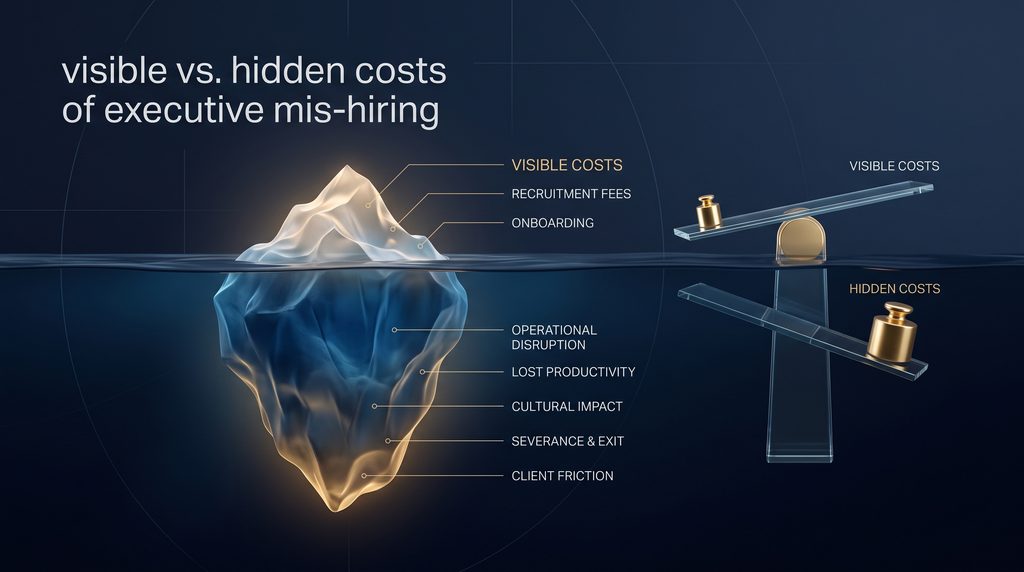
Most boards see only the visible part: the salary paid to someone who did not perform. The larger losses sit in P&L lines nobody attributes to the hire.
Strategic Context: The Financial Multiple Behind an Executive Misfire
(The ₦100 million figure is illustrative. Substitute your own numbers.)
Nigeria’s operating environment amplifies every line. A leader who loses two quarters to poor judgment is spending capital that is already losing value. Strategy paralysis typically runs six to twelve months before the damage is undeniable, and by then the replacement inherits a business that needs unwinding before it can be moved forward.
The sections below break the multiple into its components, explain why misfires are common in Lagos and Abuja, and set out a framework boards can apply before signing an offer.
The Anatomy of the Cost
Direct Financial Hits
These are the costs finance can see, and they are still routinely underestimated.
- Search and placement fees: Retained search firms in Nigeria typically charge 25% to 33% of the candidate’s first-year guaranteed gross cash compensation. On a ₦100 million package, that is ₦25 million to ₦33 million before the executive has started work.
- Sign-on and onboarding packages. Cash sign-on bonuses, relocation allowances (often USD-denominated or benchmarked for diaspora returnees and expatriates), furnished housing, club memberships and chauffeur-driven vehicles. If the hire fails early, most of this is unrecoverable.
- Severance and separation: Contractual termination payments commonly run three to six months’ gross pay in lieu of notice, plus negotiated settlements on unvested equity and statutory benefits.
- Litigation exposure: The National Industrial Court of Nigeria (NICN) applies international labour standards, including unfair labour practice and constructive dismissal principles. Terminating an executive without a documented process, a fair hearing and adherence to internal disciplinary procedures invites substantial damages. Executives fall under common law contract provisions rather than the Labour Act, which protects manual and clerical workers. That makes the quality of the employment agreement decisive. Vague non-compete and non-solicitation clauses are also routinely struck down as unreasonable restraints of trade, which lets a failed executive join a competitor or approach your clients immediately.
- The recruitment redo. A second full search retainer, legal redrafting fees, and interim leadership consultancy while the seat is empty.
Lost Operational Velocity and Missed Revenue
The costlier damage is slower and less visible.
An executive is either a decision-making engine or a bottleneck. A misaligned one delays approvals, reverses strategy mid-cycle and leaves direct reports waiting or working around them. Initiatives stall. Targets slip, and the miss often appears two quarters later as a revenue gap with no obvious cause.
The commercial consequences are concrete:
- Client and partner attrition. Tier-1 corporate clients, institutional distribution partners and regulator relationships built over years can erode quickly, often producing an immediate top-line drop.
- Misallocated spend. Poor procurement choices, vendor bloat and expensive operational pivots that the successor must write off or unwind.
- Founder and board distraction. Managing Directors are pulled back into daily operations to patch missed targets, reconcile team rifts and reassure restless clients. Board agendas shift from expansion, funding rounds and market share to performance reviews, grievance hearings and mediation.
Assume that every month a wrong executive stays in post, the business loses decision quality, and the successor rarely recovers all of it.
Cultural Contamination and Attrition of Key Mid-Level Performers
Senior leaders set the operating norms of their function, and high performers notice first.
When an executive blocks progress, takes credit for subordinates’ work or micromanages, the strongest mid-level managers and technical leads leave first. They have market mobility and they use it. The business is left with people who are passive, compliant or less capable, and who need close supervision to function.
Each departure carries its own replacement and training cost. Institutional knowledge leaves with them, which raises secondary recruitment costs across junior and mid-tier levels. High-profile executive churn also damages your employer brand on LinkedIn and in industry circles, making future senior candidates sceptical about your internal stability.
Why Executive Hiring Misfires in Lagos and Abuja
The root causes recur, and each is preventable.
Reliance on informal networks: Boards still appoint on pedigree, club affiliation and informal references rather than structured capability assessment. Networks surface candidates quickly, but they substitute familiarity for evidence, and the gaps that matter go untested.
CV inflation: Candidates often overstate their role in past achievements, claiming sole credit for growth that was driven by macroeconomic conditions, legacy contracts or large cross-functional teams. Without independent verification, those claims go into the offer letter unchallenged.
Agility mismatch: Executives whose success was built inside a multinational support engine, with large budgets, entrenched brand equity and offshore legal and compliance teams, can freeze in a lean, cash-constrained mid-market company. That environment demands hands-on execution, FX hedging agility and tolerance for erratic power and logistics. Boards rarely test for it.
Deference to seniority: Workplace hierarchy often stops junior and middle managers from challenging senior leaders early. Executive underperformance can go unchallenged for six to nine months until it shows up as a financial failure.
The Executive De-Risking Framework
1. Define the Mandate and Build a Competency Matrix
Map those outcomes to a competency matrix covering technical expertise, leadership scope, commercial judgment, stakeholder management and the operating environment the person must thrive in. Weight each criterion and have every interviewer score finalists independently before the panel compares notes. This reduces the pull of charisma and familiarity.
2. Test with Nigeria-Specific Case Simulations
3. Run Forensic Reference Checks
- Verify titles, dates, scope and reporting lines directly with former employers.
- Hold off-the-record conversations with former direct reports, cross-functional peers, and procurement or board contacts who saw the candidate under financial stress or in a crisis.
- Test specific claims: what was the baseline, what did the candidate personally deliver, and who else contributed?
- Confirm credentials with issuing bodies and check public records for litigation or regulatory issues, with the candidate’s consent and within data-protection obligations.
4. Add psychometric Profiling
5. Use a Milestone-Gated Probationary Contract
Structure a strict six-month probationary window tied to defined KPIs and deliverables. Agree the milestones before the executive starts, and hold formal board or founder reviews against them.
Have counsel draft the agreement with care:
- Tiered notice periods, for example two to four weeks during probation and three months after confirmation.
- Explicit severance caps.
- “Bad leaver” clauses that cancel unvested equity, deferred bonuses or long-term incentives on a performance-based exit.
- Narrowly drafted post-termination restraints that a Nigerian court is likely to enforce.
If the hire is not working, you will know early and can act on documented evidence, which lowers both exit cost and litigation risk.
How TalentForge Solutions Reduces Executive Hiring Risk
We begin by working with your board or founder to define the mandate and success metrics before approaching a single candidate. We map the market systematically, well beyond referral networks. Every shortlisted candidate is assessed against a weighted competency matrix, including context-specific case simulations and validated psychometric profiling. Our team conducts forensic reference and credential verification, so the CV you receive has already been tested. We then support the milestone-gated probation, so the executive is measured against the mandate from day one.

The result is fewer surprises after the offer is signed and a defensible record if a difficult conversation is ever needed. We understand executive search and recruitment in Nigeria is not a piece of cake, but our team of expert have put measures in place to ensure the process is accurate and reliable.
With offices in Lagos and Abuja, we advise Managing Directors, Chief People Officers, Founders and Boards on senior appointments across sectors. If you are planning an executive hire, reviewing one that is not delivering, or simply looking for HR advisory and workforce solutions, speak with our team at talentforgesolutions.com.ng.